 Defituna
 spot trading, lending, and leveraged liquidity
Defituna connects spot trading with liquidity pools and lending on Solana, including tools for leveraged positions. Borrowed assets increase position size while adding interest and liquidation exposure. The platform also supports TUNA staking for protocol revenue sharing; new leveraged positions depend on borrowing being enabled in the selected market.
Spot liquidity linked to lender capital
Trading, liquidity provision, and lending contribute different resources to the same market: swaps consume available liquidity, providers supply trading inventory, and lenders fund borrowing. Liquidity providers (LPs) earn swap fees when their capital participates in trades. Lenders receive interest from borrowers who use their supplied assets. A trader can exchange tokens without taking a loan, while a liquidity position can combine owned and borrowed funds. These entry paths have different obligations, even when they involve the same pool. TUNA staking adds a separate claim on protocol revenue.
Spot swaps and Fusion AMM limit orders
The spot market supports immediate token swaps and maker orders through Fusion AMM, an automated market maker combining concentrated liquidity with on-chain limit orders. A market swap exchanges tokens against available liquidity. With leverage disabled, that swap doesn’t create a borrowing obligation. Execution still involves swap fees, price impact, and a slippage tolerance. Price impact describes how the trade changes the pool price; slippage tolerance sets the acceptable deviation between expected and executed pricing.
Fusion AMM stores maker orders alongside liquidity at particular price levels. Trading through a level consumes its available liquidity and orders. This gives a maker order a different role from an LP closing trigger, which requests an exit after a price condition occurs. Filled maker orders can earn trading fees. The presence of an order doesn’t guarantee a fill: trading must reach and consume the relevant liquidity.
Leveraged spot positions use collateral and borrowed assets to increase directional exposure. Where borrowing is available, the trading interface supports take-profit and stop-loss settings, plus optional swaps through Jupiter.
Liquidity ranges and borrowed exposure
Liquidity provision supplies tokens to a pool so other participants can trade, with leverage available as an optional borrowing layer. The liquidity tools cover native pools and Orca pools. A concentrated position commits liquidity within selected price boundaries; the Full-Range option extends it across the entire price range. A narrow range concentrates capital around particular prices, but market movement can leave that liquidity inactive. The position’s own capital is its margin, while the value of margin plus borrowed assets determines its opening size.
Range placement and token balances
A concentrated liquidity position changes its token composition as the pool price moves through its range. That adjustment affects exposure even before borrowing enters the calculation. Price divergence can make the pooled tokens worth less than holding the original token amounts outside the pool. This difference, before fees, is impermanent loss. An initial hedge can offset sensitivity to small price movements at its starting price, yet later movements change the pool’s holdings and weaken that offset. A pseudo-delta-neutral setup therefore retains volatility risk. Fee income, the liquidity range, and the debt composition all contribute to its outcome.
Debt composition and compounding
Borrow ratio and repayment assets
The borrow ratio controls the mixture of tokens the position owes, which changes its directional exposure. Repayment concerns the borrowed tokens, so a rising price can increase the value of a liability. The pool’s changing inventory and its debt can move differently. Available borrowing and the selected position parameters also affect the liquidation boundaries the interface displays. Depending on the setup, an LP position can have a lower boundary, an upper boundary, both, or neither.
Reinvesting fees with and without new debt
Compounding earned fees without new borrowing lowers leverage when prices and other balances stay unchanged. For a hypothetical LP snapshot, assume $246 of margin, $492 of debt, and $26 of earned fees available to reinvest. Excluding the separate earned fees, the deployed liquidity starts at $738, or 3x the $246 margin. Hold token prices constant and exclude interest, protocol charges, and execution costs so the calculation isolates the compounding choice.
Using Reduce Leverage adds the $26 to margin, bringing it to $272 while debt stays at $492. Position size becomes $764, and leverage falls to $764 divided by $272, approximately 2.81x. Keep Leverage would pair those fees with $52 of additional borrowing, producing $816 of assets against $272 of margin and $544 of debt. Leverage then remains 3x.
Price changes, accruing interest, and charges alter those outcomes; the calculation assumes borrowing is available for the option requiring additional debt.
What costs does leverage add?
Leverage adds interest on borrowed assets alongside the protocol and execution charges relevant to the selected position. Borrowing rates adjust with lending-pool utilization. Utilization measures the proportion of supplied funds borrowers currently use. A position’s borrowing cost reflects the debt amount, each borrowed asset’s rate, and how long the debt remains open. In leveraged spot trading, Funding estimates the interest cost of keeping leverage open for 24 hours at the displayed rate. The annual percentage rate, or APR, expresses borrowing interest on an annualized basis without compounding.
The LP yield estimate uses trading activity from the preceding 24 hours within the selected range and excludes borrowing costs. Trading volume can change, so that estimate doesn’t establish future earnings. Pool-specific protocol charges can apply to collateral and borrowed funds, while successful closing triggers and liquidations have their own fees. Opening an LP position also requires a refundable deposit, separate from those charges, which returns when the position closes. Solana transaction fees and any priority fee add network costs.
Leaving the active liquidity range can interrupt new swap-fee earnings while outstanding debt continues to accumulate interest.
Lending interest and TUNA revenue sharing
Lending earns interest from borrowed assets, while TUNA staking distributes protocol revenue through a separate token-based arrangement. Lending pools display supplied assets, borrowed amounts, utilization, supply yield, and a deposit limit. The Main and Isolated lending options offer different exposure: an isolated deposit supplies only borrowers in the selected market. Isolation limits the connection to other lending markets, but lenders still bear the chosen market’s losses. For the same token at equal utilization, an isolated pool may offer a higher supply APY than the Main pool. That potential increase reflects additional market risk.
Staking the protocol token
TUNA stakers receive a proportional share of the staking revenue pool, with rewards denominated in SOL. Their earnings therefore depend on protocol revenue and their share of total stake. The staking dashboard’s APR averages daily snapshots over the preceding 30 days; it doesn’t fix the next month’s return. Staking also exposes the holder to changes in TUNA’s value. Annual percentage yield, or APY, incorporates compounding, so an APY figure and a simple APR describe different calculations.
The July 2026 lending interruption
A lending-pool exploit on 16 July 2026 created a deficit in the USDC lending pool. On 17 July, the team announced a borrowing pause after patching the vulnerability and stated the AMM was unaffected.
Later team updates announced that affected USDC lenders could withdraw available balances after losses were shared across depositors, with remaining deficits recorded. Post-exploit depositors were promised separate manual transfers by 29 July. The team later planned to redirect protocol revenue into a repayment wallet and transfer funds to affected users once the full target amount had been collected. It clarified that this concerned the treasury wallet and stakers continued receiving revenue. These announcements don’t confirm completed repayments or current borrowing availability in each market.
Liquidation boundaries and trigger execution
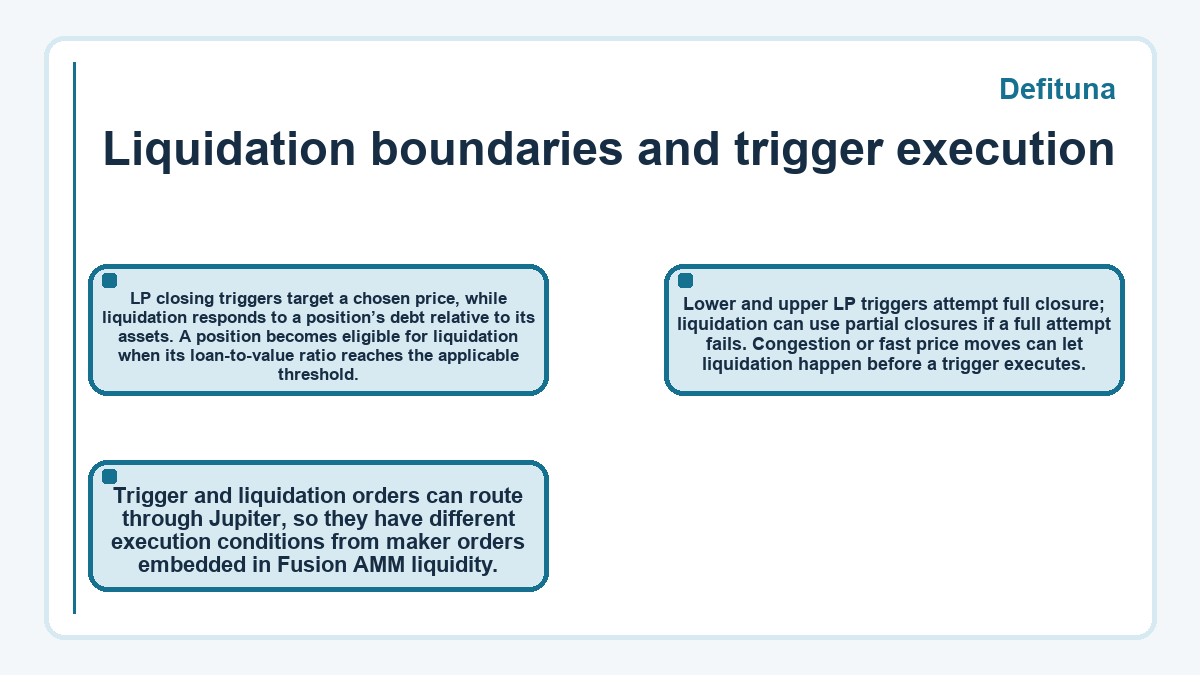
LP closing triggers target a chosen price, while liquidation responds to a position’s debt relative to its assets. A position becomes eligible for liquidation when its loan-to-value ratio reaches the applicable threshold. Lower and upper LP triggers attempt full closure; liquidation can use partial closures if a full attempt fails. Congestion or fast price moves can let liquidation happen before a trigger executes. Trigger and liquidation orders can route through Jupiter, so they have different execution conditions from maker orders embedded in Fusion AMM liquidity.
Key questions about Defituna
-
Can I supply a liquidity position with just one token?
- A single-token deposit can work when automatic swapping can convert part of the deposit into the pool’s required token ratio. If Disable Swap is enabled, the deposited assets must already match that ratio. The range, borrowing mixture, and leverage settings influence the target composition and any opening swap.
-
How can I connect to Defituna on a phone?
- Defituna requires users to be at least 18 and legally able to accept its terms. Its access rules exclude sanctioned parties and anyone located, incorporated, or established in prohibited jurisdictions, including the United States and the United Kingdom. Citizens and residents of those jurisdictions are also excluded. Eligible users can connect through a supported wallet’s in-app browser. Supported options include Phantom and Backpack. The wallet needs the assets relevant to the intended action and enough SOL for transaction fees. Connecting a wallet establishes the connection; it doesn’t itself open a position or supply tokens to a lending pool.
-
Does lending interest require a manual claim?
- Lending interest compounds automatically, so you don’t need to claim it separately. An LP position has its own optional auto-compounding setting and a choice between maintaining leverage and adding earned fees without new borrowing.
-
When can I withdraw TUNA after unstaking?
- Unstaked TUNA becomes withdrawable after a 24-hour cooldown under the staking system’s withdrawal rule. The cooldown begins with unstaking, rather than the original staking deposit. This timing applies to TUNA staking and doesn’t set a withdrawal timetable for a lending deposit or an LP position.
-
Can I reverse the Lock option after creating an LP position?
- The Lock option permanently locks the LP position. Accessing it first requires enabling Allow Position Locking in settings. That permission exposes the option; choosing Lock applies the permanent restriction to the position. Ordinary liquidity provision doesn’t require enabling this optional feature.
Last updated ·