 Defituna
 leveraged liquidity increases position size relative to your own equity
Defituna leveraged liquidity combines deposited margin with borrowed tokens to create a larger liquidity position. Position size measures the assets deployed; equity measures their value after subtracting debt. Interest, changing token balances, and price movements affect that equity. New leveraged positions also require the selected market to permit borrowing.
Position size, debt, and equity measure different claims
Wallet margin and lender capital fund the asset side of a leveraged position, while debt records what must return to lending vaults. These quantities describe different claims on the same position assets, so gross liquidity value can’t substitute for the capital you own.
At opening, notional size equals margin plus the value of borrowed tokens, with both amounts measured in matching valuation units.
Using matching prices and valuation units, V represents current asset value and D current debt value; equity E equals V minus D. Current leverage equals V divided by E when equity is positive, and outstanding loan balances include accrued interest. Borrowing amounts remain denominated in their own tokens even when a dashboard translates them into a common value, so a change in a debt token’s price changes its valuation and the equity remaining after repayment.
Equity can shrink while gross position value remains substantial, increasing effective leverage even without additional borrowing.
Increasing a position with external funds preserves its current leverage, potentially expanding borrowing alongside liquidity. Repay Debt uses external funds to repay tokens owed to the lending vaults. These controls change the capital structure differently: maintaining leverage scales assets and liabilities together, while repayment reduces the liability side directly. Adding funds doesn’t always produce the same leverage reduction as repaying debt.
How does the borrow ratio change directional exposure?
The borrow ratio changes which tokens you owe, while your liquidity range determines the tokens your position holds. Repayment uses the borrowed tokens, so matching leverage multiples don’t establish matching price exposure because held assets can reinforce or offset the effect of debt. The opening conversion and chosen range shape asset balances; the borrow ratio sets the liability mix. Borrowing alone doesn’t establish a short position when holdings of the borrowed asset equal or exceed the amount owed.
Long farming combines borrowing with holdings to retain positive exposure to an asset’s price, while short farming arranges liabilities and holdings for the opposite exposure. Pseudo delta-neutral farming aims to offset small price movements around the starting price. That balance changes as swaps alter inventory. It doesn’t make equity independent of price or remove borrowing costs, and neutrality in one valuation token doesn’t imply neutrality in the other.
Deposit conversion matches inventory to the selected range
Within supported Orca pools and Defituna’s native Fusion AMM pools, an opening swap matches deposited assets to the mix the chosen range requires. With swaps permitted, a single-asset deposit can supply the required mix through conversion; enabling Disable Swap requires the deposit to match that ratio already. Swap size follows the range, leverage, and borrowed-token composition. The token supplied from your wallet therefore doesn’t establish the final inventory or its directional exposure by itself.
What happens to borrowing costs outside the liquidity range?
Borrowing costs continue while debt remains open, even when an out-of-range position stops earning new swap fees. The range specifies where concentrated liquidity participates in trading, and in-range swaps change the relative token balances. Outside that band, inventory becomes one-sided; its market value and the debt valuation can still change.
Narrower ranges concentrate liquidity over fewer prices and can increase fee earning efficiency while active, although a smaller price move can reach their boundaries. Wider ranges spread capital across more prices, reducing that concentration. The Full-Range option covers the pool’s entire supported price range. This changes liquidity placement; it doesn’t cancel a loan or fix token values. The selected band’s width alone can’t establish a net return.
Impermanent loss measures the shortfall in pooled asset value before fees against holding the same starting tokens after relative prices change. Interest adds a separate borrowing cost.
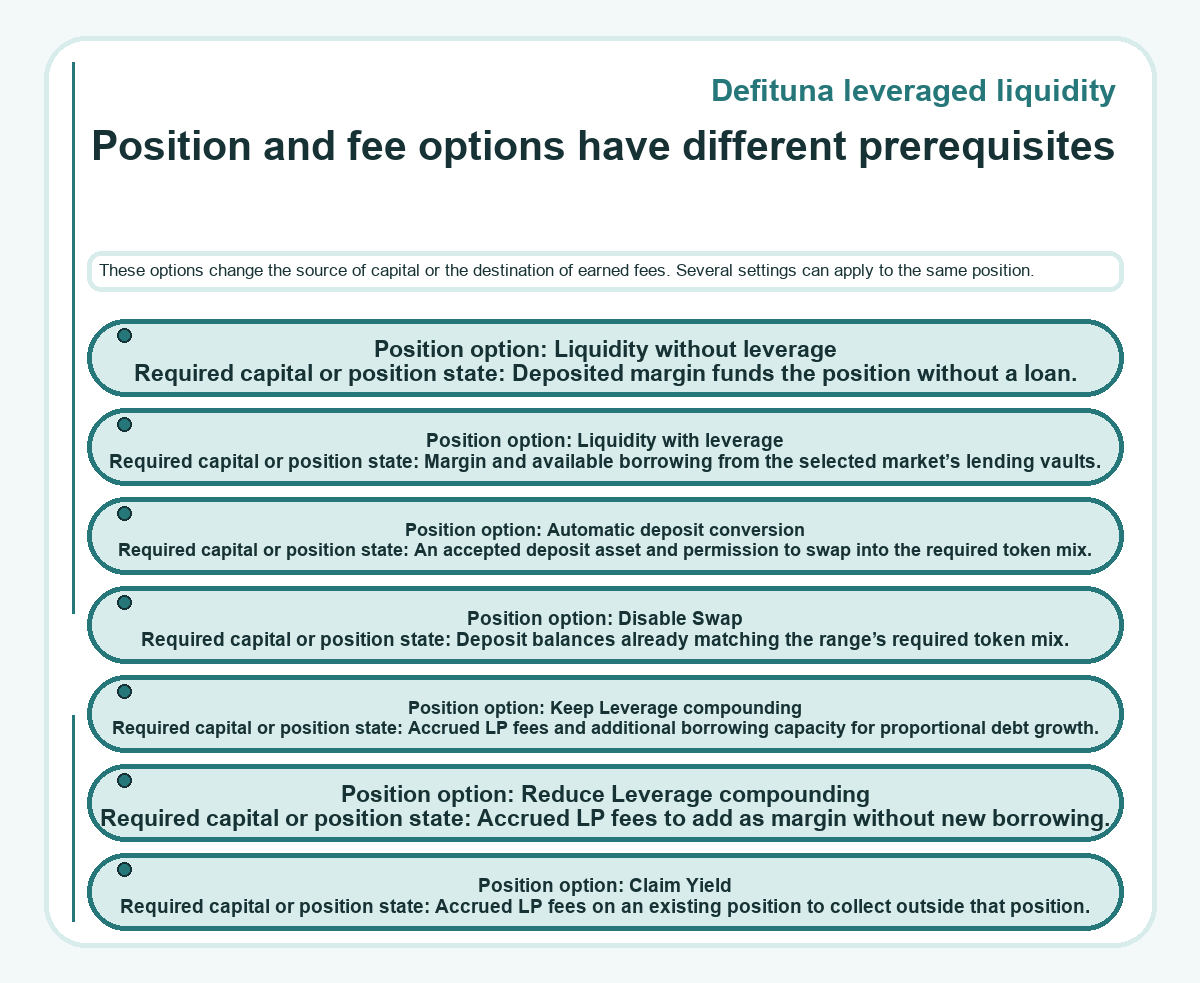
Position and fee options have different prerequisites
These options change the source of capital or the destination of earned fees. Several settings can apply to the same position.
| Position option | Required capital or position state |
|---|---|
| Liquidity without leverage | Deposited margin funds the position without a loan. |
| Liquidity with leverage | Margin and available borrowing from the selected market’s lending vaults. |
| Automatic deposit conversion | An accepted deposit asset and permission to swap into the required token mix. |
| Disable Swap | Deposit balances already matching the range’s required token mix. |
| Keep Leverage compounding | Accrued LP fees and additional borrowing capacity for proportional debt growth. |
| Reduce Leverage compounding | Accrued LP fees to add as margin without new borrowing. |
| Claim Yield | Accrued LP fees on an existing position to collect outside that position. |
Position and fee options have different prerequisites
These options change the source of capital or the destination of earned fees. Several settings can apply to the same position.
- Position option: Liquidity without leverage Required capital or position state: Deposited margin funds the position without a loan.
- Position option: Liquidity with leverage Required capital or position state: Margin and available borrowing from the selected market’s lending vaults.
- Position option: Automatic deposit conversion Required capital or position state: An accepted deposit asset and permission to swap into the required token mix.
- Position option: Disable Swap Required capital or position state: Deposit balances already matching the range’s required token mix.
- Position option: Keep Leverage compounding Required capital or position state: Accrued LP fees and additional borrowing capacity for proportional debt growth.
- Position option: Reduce Leverage compounding Required capital or position state: Accrued LP fees to add as margin without new borrowing.
- Position option: Claim Yield Required capital or position state: Accrued LP fees on an existing position to collect outside that position.
Compounding can preserve or reduce leverage
Compounding reinvests earned fees, with the chosen mode deciding whether debt grows alongside the margin. Reduce Leverage adds accumulated fees as margin without increasing the borrowed amount. The new margin lowers leverage and can move liquidation boundaries farther from the current price. Keep Leverage reinvests fees with additional borrowing, scaling assets and liabilities together to retain the leverage ratio during compounding.
A constant leverage multiple can conceal a growing loan balance under Keep Leverage, whereas Reduce Leverage leaves principal unchanged while interest continues accruing. Neither mode establishes a fixed earning rate: each reinvests fees the position has already earned, and later swap activity determines further income. Claiming fees takes them out as a separate payout, without adding them to the margin supporting debt.
Funding and protocol fees affect the equity you retain
Borrowing interest depends on each debt token’s rate, amount owed, and time outstanding, with lending-pool utilization influencing borrowing rates. An annual percentage rate (APR) isn’t the cost for a shorter holding period, and different borrowed tokens can carry different rates. Borrowers pay the lending vault interest, shown as Funding on the LP dashboard. Pool-specific protocol fees add separate costs on collateral or borrowed funds. Successful closing triggers carry their own execution fee.
The projected 24-hour yield uses recent trading in the selected range and accounts for leverage, although it excludes borrowing costs and can’t stand in for net profit. A collateral-based return also uses a different denominator from a return measured against total position size. Fee income and funding need the same measurement period, and changes in collateral value and applicable protocol fees also enter profit and loss (PnL).
Can a closing trigger guarantee the amount of equity returned?
A closing trigger can’t guarantee returned equity because market movement and execution affect both asset value and debt repayment. Lower and upper triggers request closure at their chosen price conditions, although Solana congestion can delay or prevent execution. A fast price move can reach a liquidation boundary before a nearby closing trigger executes. Selecting an output token specifies the intended token after closure; it doesn’t fix the amount received or remove swap slippage.
Liquidation eligibility depends on the loan-to-value (LTV) ratio, which measures debt value against position value, and the market’s maintenance threshold. Accrued interest changes the debt used in that ratio. The asset mix, borrow ratio, and range affect where liquidation prices fall. A setup may show a lower boundary, an upper boundary, both, or neither. The absence of a displayed price doesn’t remove interest costs or contract risk. Liquidation uses position assets to repay debt, charges applicable fees, and returns any remaining funds.
If a full liquidation fails, the system can try closing smaller portions. That fallback addresses execution difficulty; it doesn’t restore lost equity.
Borrowable liquidity and market settings qualify new leverage
New leveraged positions require enabled borrowing and usable capital in the relevant lending vaults. By 17 July 2026, borrowing had paused as a precaution after an exploit left the USDC lending pool with a deficit; its automated market maker remained unaffected. Spot trading activity alone doesn’t establish borrowing access. Opening or expanding a leveraged position depends on the selected market’s borrowing state and available funds.
Everyday questions about Defituna leveraged liquidity
-
Can I reduce a leveraged LP position without closing it completely?
- The manual Close panel supports reducing position size with its partial-close slider. Lower and upper triggers request full closure, so they don’t substitute for a manually selected partial reduction. Reducing size also differs from Repay Debt, which uses external funds to reduce borrowing.
-
Why can my current margin differ from the amount I deposited?
- Current margin changes with the open position, while Margin (Initial) records the entry deposit. The dashboard’s current Margin excludes leverage, uncompounded yield, and funding. Comparing those fields therefore doesn’t capture every part of profit and loss. Pending fee income and borrowing costs need their own entries when assessing the position.
-
Will changing the PnL chart’s display token change my debt?
- Changing the PnL display token changes the benchmark used to measure performance, so results can differ between token units without converting your loan, changing its borrowed-token amounts, or changing which tokens you owe when the position closes.
-
What can prevent automatic LP compounding from running?
- Automatic LP compounding requires an event worth approximately $16, including any borrowed funds, and execution isn’t guaranteed. The threshold applies to total event size, so it doesn’t always mean $16 of unclaimed fees. Keep Leverage can include additional borrowing, whereas Reduce Leverage adds earned fees without a new loan.
-
Can I open a leveraged Defituna LP from the United States?
- Defituna’s services exclude users in the United States, including those seeking leveraged liquidity positions. The exclusion also covers the United Kingdom and other jurisdictions where use is prohibited. A compatible wallet or a successful wallet connection doesn’t override those access rules.
-
How does the refundable opening deposit differ from borrowing interest?
- The opening deposit is a separate upfront amount the LP interface returns when the position closes. Borrowing interest pays for outstanding loans and reduces net earnings; closing doesn’t refund it. The deposit affects initial wallet outlay, while interest depends on debt balances, token-specific rates, and the time the loan remains open.
Last updated ·